Between 2011 and 2016, Betty Finke was a regular columnist for The Arabian Magazine. Some fifteen years down the line. we thought that now would be a good time to share Betty’s articles, which remain as pertinent as ever.
It is September and the show season is gathering momentum as it approaches the Title shows. But as we look towards the Nations Cup, the European and World Championships and busily speculate about who, if anyone, will be the next Triple Crown winner, aren’t we forgetting something? Let us take a moment to remember that the show-ring isn’t everything.
In August, after having been to several shows in succession and enjoying them a lot, I did something different for a change: I attended a regular horse show, a local event with dressage, showjumping and cross-country competitions. A weekend, as it happened, was the hottest of the year, where riders, including many children and teens, came together and enjoyed two days of fun and sport with their horses.
Actually, it wasn’t entirely ‘regular’ as there is something a bit different about this particular event: one of the organisers happens to be an Arabian breeder, and as a result, there are competitions for Arabians. This means that purebred, Anglo and part-bred Arabians have the chance to compete in each discipline among themselves but also, should they want to, against other breeds. Which some of them do; and, as a matter of fact, they do pretty well.
Case in point: a Shagya-Arabian gelding, Olino, who was really a last-minute replacement because his rider’s dressage horse was unable to compete. So, he borrowed Olino, who is actually his owner’s leisure horse, and won the dressage classes. Three of them, to be precise – one against 20 warmblood horses. Not bad for a weekend’s replacement duty!
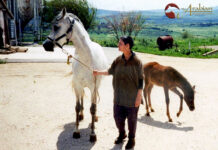
Now, there weren’t very many pure-breds around, just four. One of them was a grey stallion called Al Ashar. He is seven years old, stands 15hh, and has a pedigree that isn’t quite up-to-date fashionable show-ring material but contains some pretty famous names such as Ansata Halim Shah, Hanan and El Perfecto. He’s almost half Egyptian, 1/8 Spanish, approximately 3/8 Polish, and every inch an Arabian. He was bred by a very small German breeder, who still owns him and who has done what few owners do these days: invested in the very best under saddle rather than in-hand training. She was fortunate enough to find a really good professional trainer/rider who likes Arabians and knows how to ride them, and is also willing to compete with them.
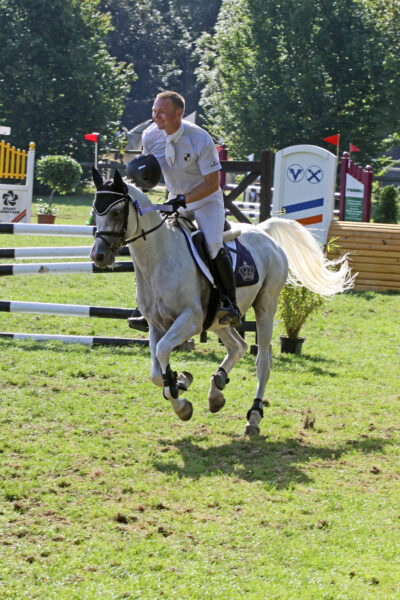
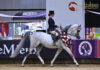
During these two days, Al Ashar competed five times in three disciplines. Dressage isn’t really his favourite sport; he placed sixth, which isn’t bad among 14 competitors. He got two second places in showjumping – once behind an Anglo Arab and once behind a Trakehner – and he won both cross-country courses hands down, one of these was the open competition. Four Arabians entered against eight warmblood horses, and they placed first to fourth, the pure-bred winning, followed by an Anglo, a part-bred, and another Anglo. Needless to say, Al Ashar also won the combined jumping prize and the two-day-event. And just for a change of pace, he took time out between jumping and cross-country to get himself decked out all in pink and carry a little girl to victory in the lead rein pony class… Oh, and I should perhaps mention that he is an active breeding stallion, licensed, performance tested and the sire of prize-winning pure and part-breds, although I very much doubt the judges in the lead rein class would have suspected this.
Now, this, in my book, is a much better way to promote Arabians than all the stylised antics of the show-ring. At the end of two days of competition in the blazing sun, there was this beautiful white stallion flying around the ring at top speed, doing his lap of honour, tail held high, ready to do it all again, and the announcer’s voice coming over the loudspeaker: “There he goes – a pure-bred Arabian – drinker of the wind!”
I am hoping that some of the spectators that day have gone home with this image fixed in their memories. And if they ever come across one of those articles that appear from time to time, pointing at show-ring abuse and claiming that Arabians are over animated, crazy, unrideable horses that look pretty and aren’t much use for anything else, I hope they will remember and know that there is a whole different side to Arabians. And who knows, some of them might eventually become owners and even breeders themselves and go on to inspire others. It is these people and horses that are the real backbone of the breed.
Printed in The Arabian Magazine September 2012