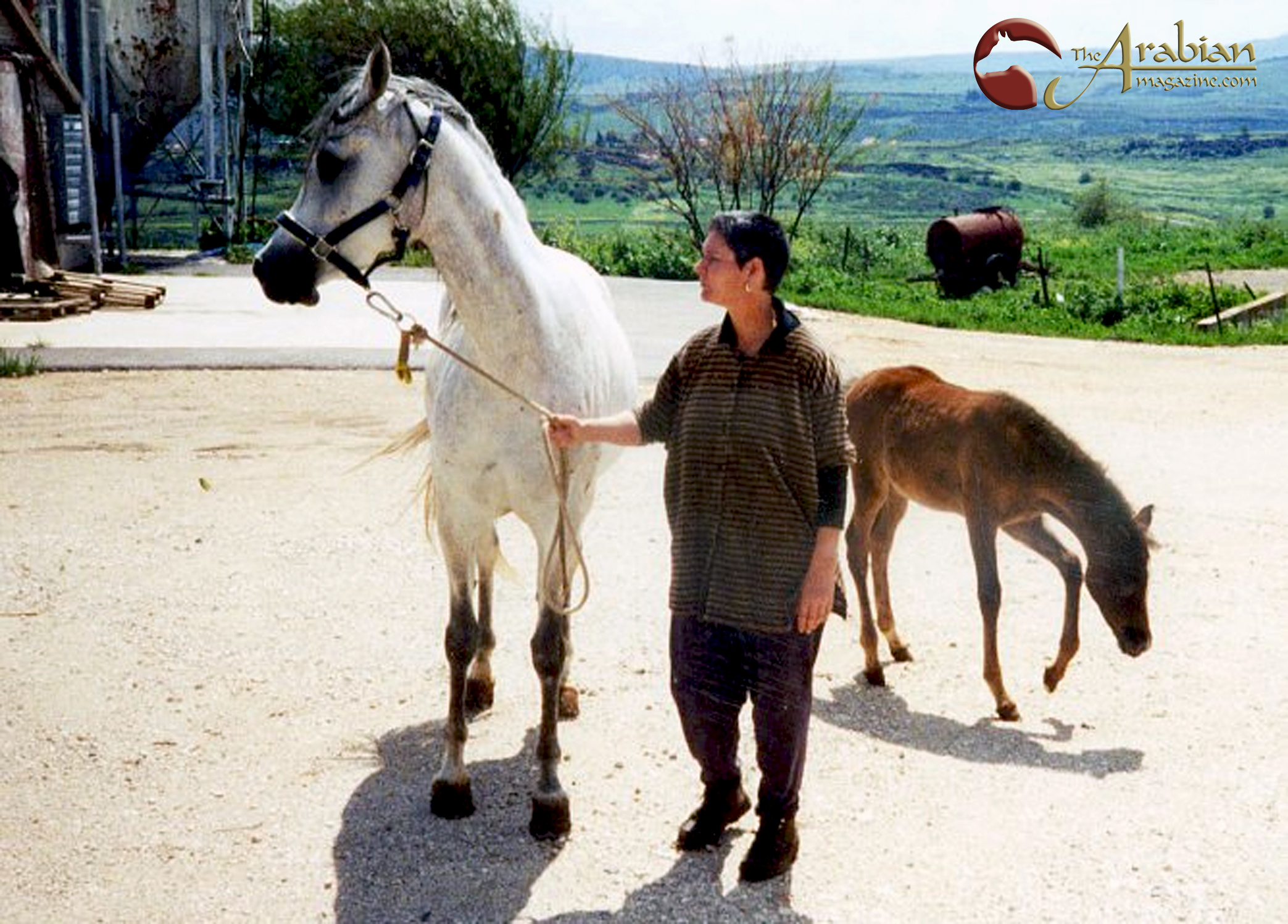
In February, Tzviah Idan passed away suddenly at her home in Israel. Tzviah had a long connection with The Arabian Magazine and in honour of her memory, we are sharing this feature – A Breeder’s Journal: Remembering Alhambra – as written by Tzviah in 2018. The loss of this remarkable horsewoman has been felt keenly around the world, and it is a privilege to share her words here with you.
This is the final part into Tzviah’s insightful journey as a breeder, as seen through her mare, Al Hambra B.
Part one Part two Part three Part four
A painful farewell
By 2009, Alhambra had produced seven foals for us. At just eleven years old, she was in the very best of health and once again in foal, this time to the significant sire Nader al Jamal (Ansata Sinan x Savannah CC). Little did we know that this foal would never be born.
Throughout the years, whenever I would tell the story of how we lost Alhambra, I would point out the mistakes that were made by others that ultimately led to her death, observing myself angrily assigning away the blame. This was because my mare suffered long and hard, and the cause of her suffering was human error. And this was also because deep inside I actually blamed myself for her suffering, and was simply wracked with guilt.
Enough time has passed, and the pain has subsided to the point where I can now accept that it was simply a misadventure, a chain of unintended mistakes that ended in tragedy. I am beginning to forgive and perhaps finally, to heal, although tears are still streaming as I write this.
Here is the story of what happened…
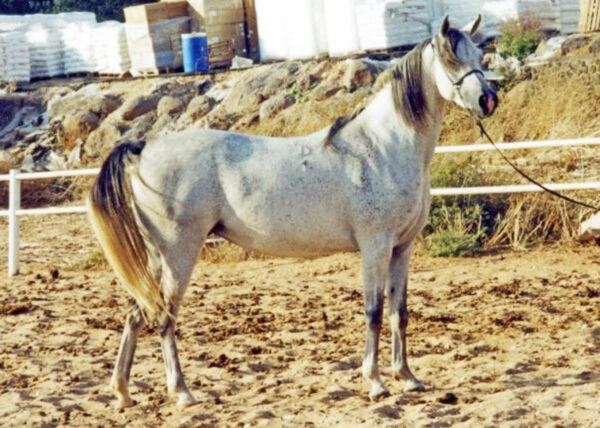
Danny, the very responsible young man hired as stable help had just returned from a three-day furlough where he had been reunited with some old school chums. On his first day back to work, he suddenly asked for the afternoon off in order to again meet with these same friends. I refused, feeling that the request was unreasonable being that he had just returned from an extended leave, and besides, I had my own plans for the day.
Danny was not very happy with this situation and eventually decided to take matters into his own hands. He figured that if he brought the horses in from the pasture early enough and had their evening feed all prepared in advance, he could complete his chores as scheduled and still be on time to meet his friends. So, unbeknown to me, he brought the horses in from pasture and closed each into its own stall several hours early. He then prepared the evening grain ration for each, placing the proper amount of grain in each individual feed tub, and each tub in front of the proper stall. The horses could see but could not reach these tubs.
Danny then headed back to his farm lodgings to prepare at leisure for a night on the town, planning to serve the horses their grain just as he headed off the farm. All very nice and orderly, but he had made one fatal error: he had forgotten to padlock Alhambra’s stall door.
Our simple stable door latches were not completely ‘horse proof’ and so were equipped with a set of identically-keyed padlocks. Each time we stabled our horses, we would padlock each stall door to prevent it opening in case a horse played with and succeeded in undoing the latch. One can easily imagine how Alhambra and the others, intrigued by the challenge of getting access to that tantalising grain, worked long and hard on their door latches that day. As luck would have it, Alhambra eventually succeeded in this task.
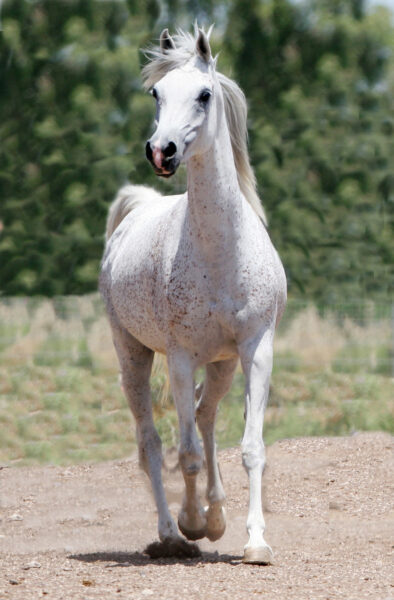
I returned to the farm later that afternoon, earlier than expected. Noticing that the horses were not in their paddocks, I walked down to the stables to discover Alhambra wandering freely down the aisle way. By this time, she had polished off her own dinner as well as that of several of her herd mates as she methodically worked her way done the stable aisle.
Obviously, the situation was very serious and after locking her back in her stall I phoned the vet for instructions and help. Gentle Noga had ceased practicing and moved on to a new career, and we had recently started working with an extremely competent equine practitioner, one of two partners. Both were very much in demand and travelled a wide geographic area every day to service their numerous clients. Thus far, they had only done routine work for us, so neither side had taken full measure of the other.
I telephoned the vet who normally came out to our farm to explain that Alhambra had devoured the entire grain ration of six of our horses and that emergency intervention was required if we were to save her. Unfortunately, this conversation took place while he was in the middle of treating another horse, and he did not give me his full attention. He misheard me, believing that I had told him that Alhambra had eaten six kilograms of grain, when in reality she had probably devoured close to six times that amount. Based on that initial misunderstanding, and his assumption that I was simply someone who panicked easily, the vet vastly downgraded the severity of Alhambra’s condition in his own mind.
I told him that I had never personally dealt with laminitis and asked him what I could do to help prevent its onset and he suggested that I hose down the mare’s feet with cool water. Later I understood that if he had only truly grasped her condition he would have instructed me to immediately pack or soak all of her feet in ice water.
It was only when he arrived several hours later that our vet realised that he had totally misunderstood what I had been telling him from the start and because of this, we had missed the proverbial boat. By then Alhambra was already suffering from very severe laminitis in both front and one hind leg. There was little we could do to reverse the damage already done, but we could still follow the standard treatment protocol, relieve her pain, and provide whatever additional supportive care seemed necessary.
A horse stricken with severe laminitis suffers from unrelenting and excruciating pain and distress. One cannot appreciate the extent of this distress until one witnesses it personally. Alhambra was so severely stricken that most of the time she remained lying down to find what little relief she could. Of course, our vet provided the very best professional care, including pain medication, special feed, special shoeing and more. His guarded prognosis was to continue to follow the proper protocol and to give her time.
After some weeks had passed, the light had gone completely from Alhambra; she had sunk deeply within herself and was severely depressed. It was excruciating to spend time with her and almost as bad to leave her side.
I was right beside her when she eventually aborted her foal, a filly, and I was also with her when she took her final breath. She slipped quietly away while I was absent-mindedly stroking her neck, whispering sweet endearments. When it finally dawned on me that my beloved mare was gone, I could only be grateful that her suffering had ended.
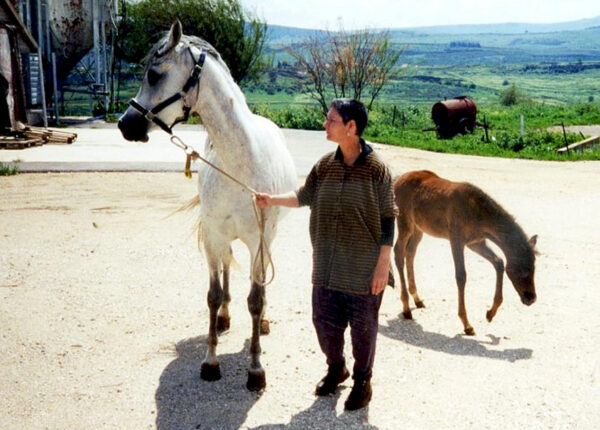
Many years and many Arabians later, I sometimes wonder what we might have accomplished if we had only had the chance to breed Alhambra to this or that particular stallion. When I catch myself doing this, it makes me smile. My heart still soars when I watch her progeny racing through the paddocks with their tails up and their manes flying. Sure, I still wipe away tears while recalling the way she left us. But I have also come to a realisation… That it is only by going through just such baptisms of fire, by persevering through those epic highs and agonising lows, that one is granted the right to call himself an Arabian breeder.
I personally believe that it is altogether worth it.
Rest in peace, Tzviah. Yours is a light that shall be truly missed.