A month ago today, the wonderful Tzviah Idan passed away suddenly at her home in Israel. Tzviah had a long connection with The Arabian Magazine and in honour of her memory, we are sharing this feature – A Breeder’s Journal: Remembering Alhambra – as written by Tzviah in 2018. The loss of this remarkable horsewoman has been felt keenly around the world, and it is a privilege to share her words here with you over the coming days.
In February of this year [2018], my straight Egyptian foundation mare *Alhambra B would have celebrated her 20th birthday. It is hard to believe that it’s eighteen years since I first laid eyes upon her, and almost nine years since we lost her. Certainly, most of us can look back over years of breeding and remember that one very special mare who played a pivotal role in their particular programme. For me, that special mare is, and will always be, Alhambra.
Long-time breeders typically can draw from a deep well of stories regarding certain unforgettable horses. Some of these memories evoke joy and satisfaction, some come dampened with tears of heartbreak and grief, and still others raise goosebumps about the silent yet fluent communication that often exists between our two very different species. I have owned and raised dozens of Arabians from a variety of sources for over four decades, and my very favourite stories involve either Alhambra herself or one of her special progeny.
All of these stories trace back to mid-June of the year 2000 when a long-time fantasy transformed into reality and I made my first of many visits to the historic Hungarian State Stud at Bábolna. This was to be strictly a learning, ‘get acquainted’ trip – or so I had imagined – and fortunately, I made the journey with someone who was both fluent in the Hungarian tongue and very much at home within Magyar culture: my friend and fellow Israeli Arabian enthusiast, Kuti Aharon. Kuti had previously visited Bábolna on several occasions but was, for the most part, uneducated about the Stud’s bloodlines. I, on the other hand, had been fascinated for almost two decades by the handful of ‘Bábolna Egyptians’ that had found their way to America and beyond. I had familiarised myself with the Stud’s long history, focusing on the select Arabians that the Stud had imported directly from Egypt between 1968 and 1971 and the breeding programme they established.
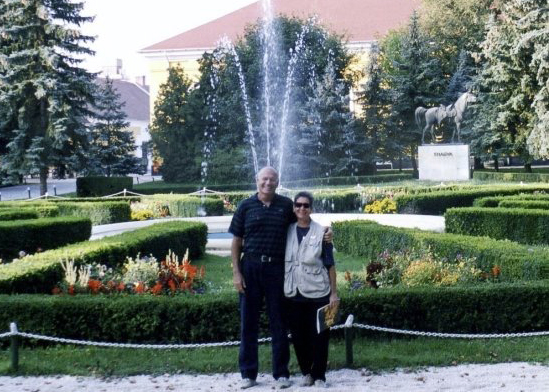
Growing up in post-World War II America before returning to my homeland of Israel, I was, like many, fairly well-travelled, but it was still a revelation to find myself in a European country where almost no one spoke English — only Hungarian, Russian, or German were understood. So, armed with the simple computer-generated list of stock provided by the Stud office, I mostly kept my own company while we toured the historic stables and generous pastures. Kuti and the Stud Director were lost in deep and unfathomable conversation, while I simply wandered, feasting my eyes on the impressive Arabian and Shagya horses and breathing in the heady scent of history.
That Arabian/Shagya stock list included a section listing horses offered for sale and here I first encountered the name Alhambra B, described as a 1998 grey filly sired by Dr Nagel’s celebrated sire Salaa el Dine (Ansata Halim Shah x Hanan) out of the Dahman Shahwaniya mare 228 Ibn Galal I (Ibn Galal I x 14 Bint Azza I), herself a daughter of the original Egyptian import 14 Bint Azza I (Tuhotmos x Azza I), tracing back to Bint el Bahreyn.
My first thought was: “What is a rare Salaa el Dine daughter doing on their sales list? Is somebody just not paying attention?”
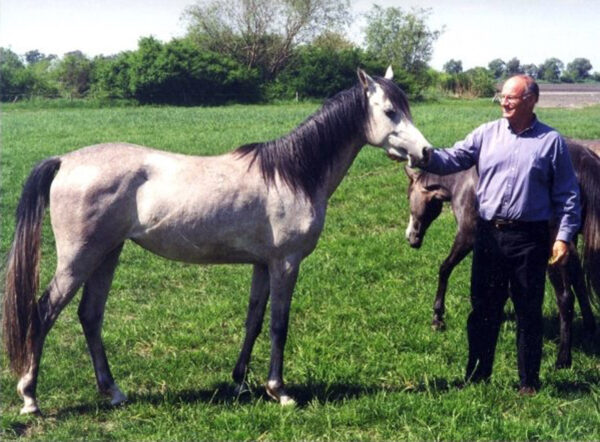
I asked Kuti to communicate to the Director that he must take us to see this filly and soon enough, we were led to a huge pasture where approximately sixty young mares and fillies grazed. As we walked that pasture the Director – not a horseman, rather a political appointee – and his assistant busied themselves studying brands and continually referred to their clipboards in an attempt to identify Alhambra. With some pride, I can write that I simply knew her when I saw her, and it was I who pointed her out to the others: a leggy, refined and long-lined filly with a very feminine head and large soft eye. At two years and five months she looked more like a yearling than a two-year old, but I had visited Dr Nagel’s farm in Germany and was very sure. After closely checking her brands, the Hungarians concurred that this somewhat gangly filly was, indeed, Alhambra B.
Alhambra’s overall quality was apparent to the educated eye, and she had a delicate look about her, much like her granddam Hanan (Alaa el Din x Mona), but like many slow-maturers, she still lacked certain finishing details and appeared slightly out of proportion. After a close study of her eighteen-year-old dam, I became convinced that Alhambra was a future foundation mare of rare promise and, being a confirmed life-long Arabian horse addict, could not bear the thought of letting her slip through my fingers. Kuti, although somewhat less convinced, deferred to my nearly thirty years of practical experience and negotiated Alhambra’s purchase as part of a larger package of mares, fillies and one stallion that we eventually exported to Israel.
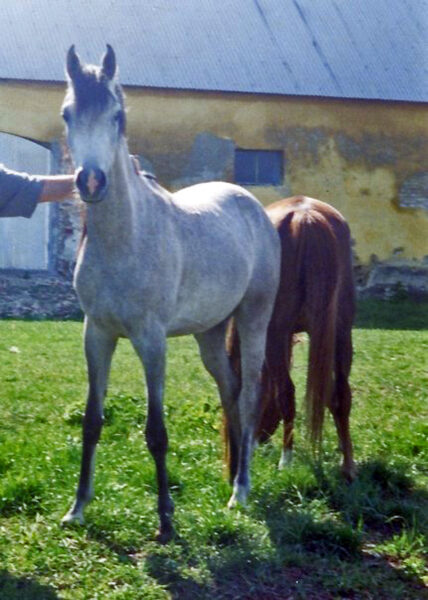
At the time we brought Alhambra and our other purchases home, our herd was divided, stabled at a few different locations as our horses were many and our own facility not yet under construction. As a three-year old, Alhambra was trained to saddle by the barn staff of Kibbutz Yizreel and later was moved to stables at Kibbutz Hukuk, much closer to my home in Tiberias.
Alhambra had meanwhile matured sufficiently to begin her broodmare career so we searched for a suitable mate and finally settled on the mostly untested but very impressive HT El Khurafa, owned by Amos Dabush and bred by High Tor Arabians in the UK. Khurafa’s parents were born in the US and later exported: his sire was the distinguished stallion Shaikh Al Kuran (ex AK Raiyeh), by Shaikh al Badi (Morafic x Bint Maisa el Saghira), ultimately the four-time winner of Britain’s prestigious Leading Sire Award; his dam, the very lovely Imperial Sonboleen, by Moniet el Nafis (Ibn Moniet el Nefous x Hoyeda), was a direct daughter of US National Champion Mare, Serenity Sonbolah (Sameh x Bint Om el Saad). Studying Khurafa’s pedigree was comparable to looking at a time-capsule photograph of the most illustrious Egyptian Arabians of the 1970s.
Using this horse seemed an opportunity to move our programme forward by going almost backwards in time, and Khurafa did not disappoint us. Alhambra settled easily and the next spring, delivered an extremely typey and refined filly that Kuti, who was at that time abroad, named Atiq Altega. This name was especially apt since he was jealous of the fact that others would enjoy seeing this filly before he would. Altega in Hebrew translates to ‘don’t touch’ or ‘touch me not’.
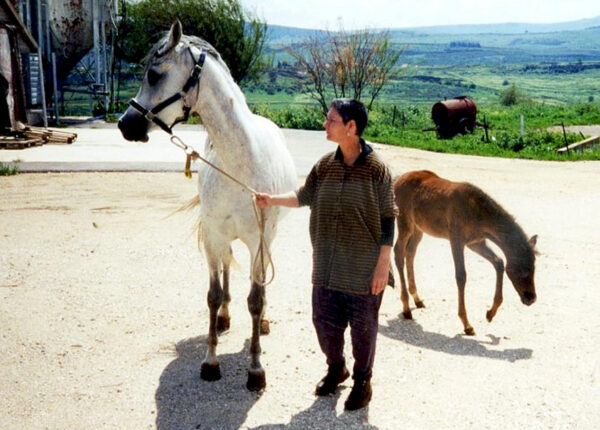
Small breeders must often sell what they would rather keep and Atiq Altega was the first of Alhambra’s foals to be sold. She had caught the attention of experienced horseman Muhsen Onallah, owner of the Al Fawaz Stud. Muhsen also became the proud breeder of Altega’s first foal, the charismatic colt, Amir al Jamal by Nader al Jamal (Ansata Sinan x Savannah CC), sold to Amir Ali while still very young. This colt developed into a highly-decorated show horse and a crowd favourite and, to date, has won five gold and one silver medal championship titles at shows held in Israel and the Palestinian Authority.
In the meantime, Altega was sold again, this time to what became her forever home at Al Sham Arabians in Um Al Fahm, located practically just around the corner from our own farm. We followed her career closely as she produced four more lovely foals for her fortunate owner, Faraj Jabarin. In 2016, we were finally able to convince Faraj to do a bit of horse trading with us. The goal was to acquire a direct daughter of Altega for ourselves and we were very fortunate to eventually bring home the very classic mare Qaswaa Al Sham (ex Leran AA), currently heavy in foal to our own Atiq Abir (Nader al Jamal x Atiq Ayla).
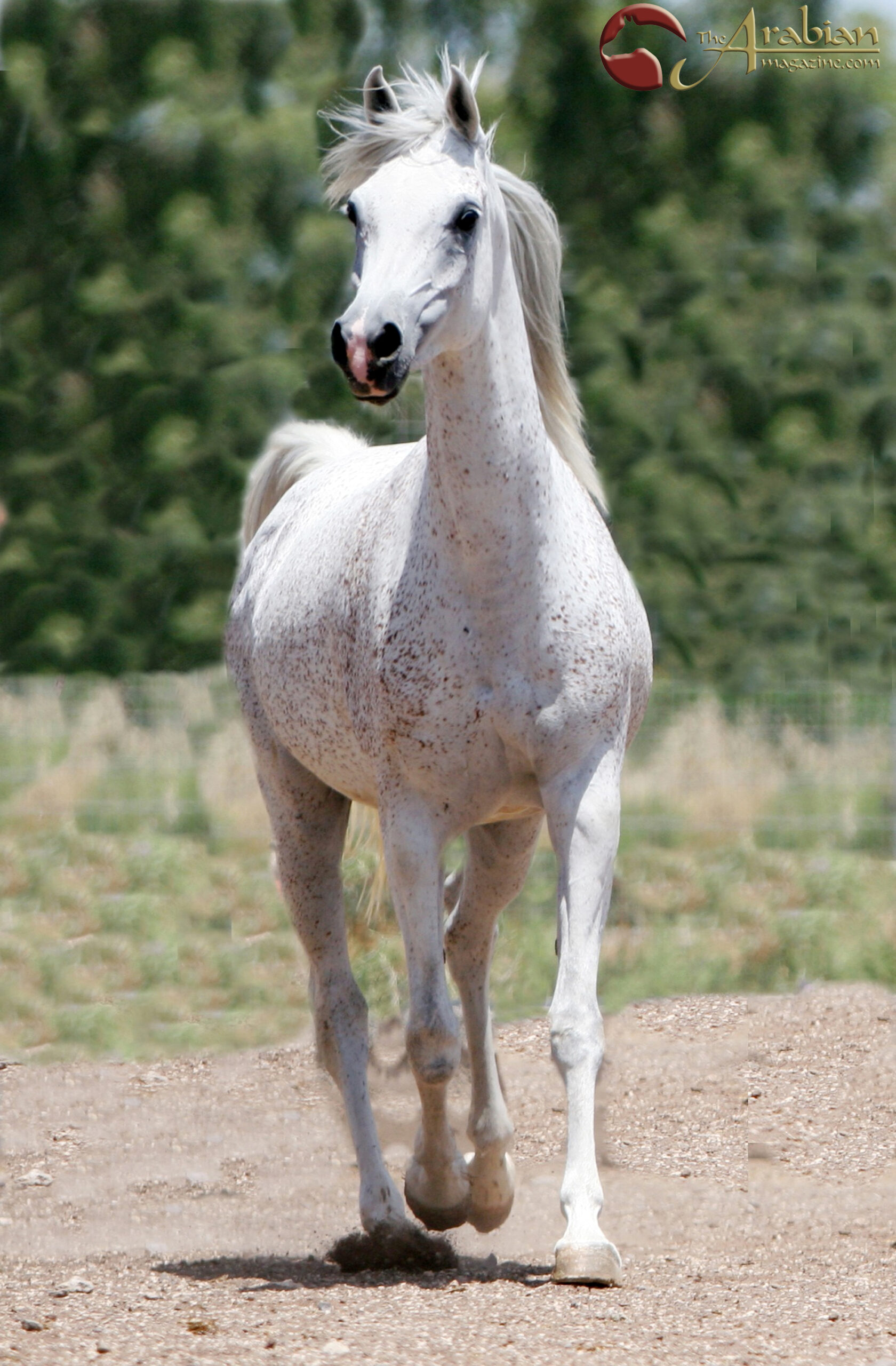
Alhambra had fulfilled her genetic promise and gradually matured into a stunning, fleabitten mare of great expression; she had an amazing presence, almost an aura about her, and very much resembled some of her sire’s most beloved and famous daughters. She also proved to be the most consistent of broodmares, quickly settling year after year with no time off required.
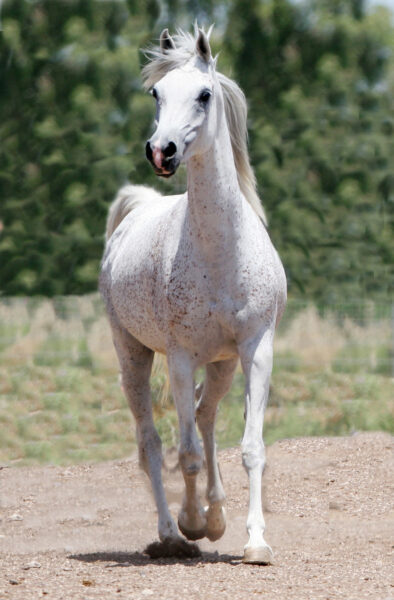
Ariela Arabians had leased the classic white stallion, Ali Valentino (Ruminaja Ali x Moniet), the first of the Ruminaja Ali (Shaikh Al Badi x Bint Magidaa) blood to arrive in Israel, and we jumped at the chance to use this horse on three of our mares. Ever faithful, Alhambra became the only one of the three to foal a filly; the other two mares delivered colts we later sold as racing prospects, and I am pleased to boast that both of these colts raced successfully.
Alhambra’s Ali Valentino filly was a beautiful individual but concerning the classic Arabian disposition that we breed for in our programme, she was a great disappointment. From the time she was born her default position was to be unfriendly and mistrustful and even with the gentlest of handling, she improved only a little. We were concerned and distressed each time she would pin her ears back for no reason, and in a desperate attempt to somehow sweet her disposition I named her Atiq Suqara, as Suqara means ‘sugar’ or ’sweetie.’
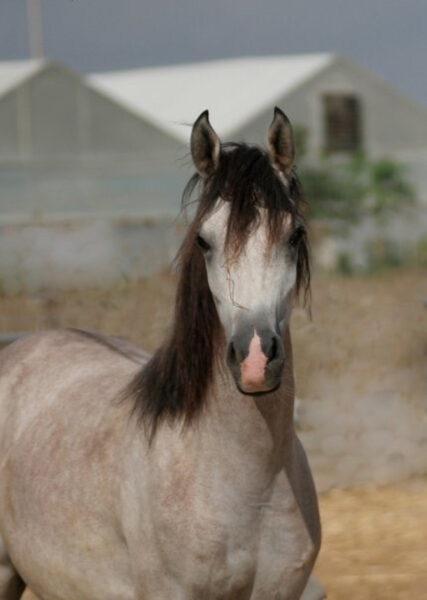
Every pot has its cover, and eventually we sold the lovely but not-so-sweet Suqara to our good friend and talented Arabian handler, Samer Owisat. A very gifted professional, Samer had no problem establishing a healthy relationship with the filly and Suqara grew up to produce four show quality foals for him, including one filly that was later exported to Jordan. When Samer built an Arabian show facility, he sold all of his own stock and Suqara ended up in the capable hands of second generation Arabian horseman, Ali Darawshe, who is hoping for a filly rather than the colts she has produced for him to date. Ali uses Suqara as his personal riding mare and recently described her as “very hot”, claiming he wouldn’t trade her for the world.
To be continued…