In February, Tzviah Idan passed away suddenly at her home in Israel. Tzviah had a long connection with The Arabian Magazine and in honour of her memory, we are sharing this feature – A Breeder’s Journal: Remembering Alhambra – as written by Tzviah in 2018. The loss of this remarkable horsewoman has been felt keenly around the world, and it is a privilege to share her words here with you.
We continue with Tzviah’s insight into life as a breeder. For part one, please click here and for part two, please click here.
The misadventures of Atiq Alaxandra
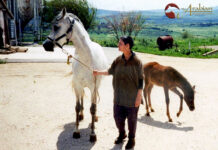
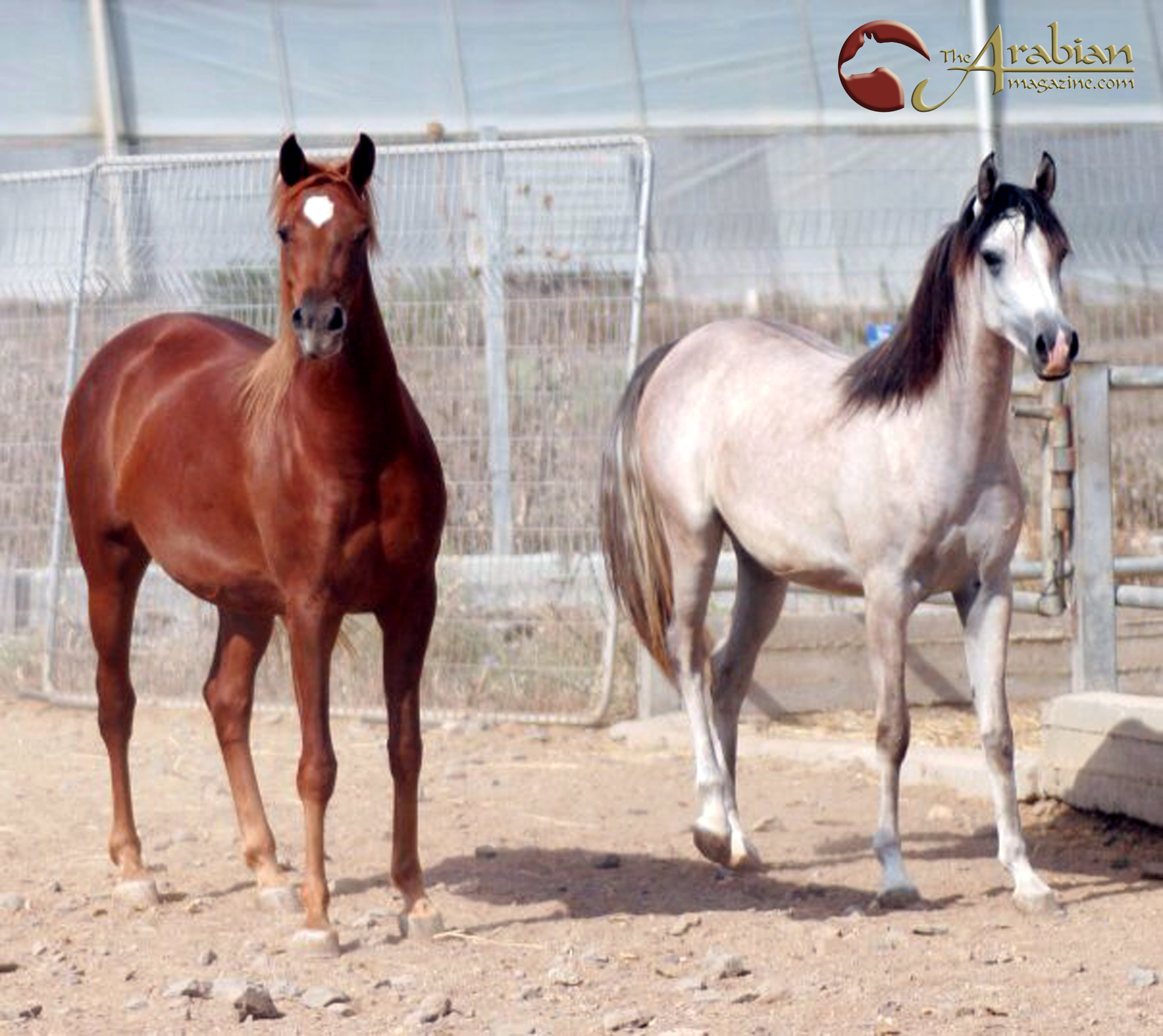
At age four, Alhambra’s dark chestnut daughter Atiq Alaxandra was a mare of definite presence, very confident of her herd standing and one of our ‘just feed me, brush me and turn me out’ mares. She was quiet and good-natured, but unlike most of our Arabians she did not actively seek out bonding with humans; herd life seemed to fulfil all her social needs. Sired by former Bábolna Chief Sire Halim Shah I (Ansata Halim Shah x 214 Ibn Galal I), Alaxandra was rather old-fashioned in type and her pedigree was, by design, ‘pure Bábolna’. She was line-bred back to Ibn Galal I (Galal x Mohga), the first foal produced by Dr Nagel’s illustrious mare, Hanan, and to the great international sire, Ansata Halim Shah (Ansata Ibn Halima x Ansata Rosetta). While Alhambra looked like her sire, Alaxandra greatly resembled her granddam, 228 Ibn Galal (Ibn Galal I x Tamria), I and shared the regal elegance and superior movement common to all the Ibn Galal I daughters we had admired at Bábolna.
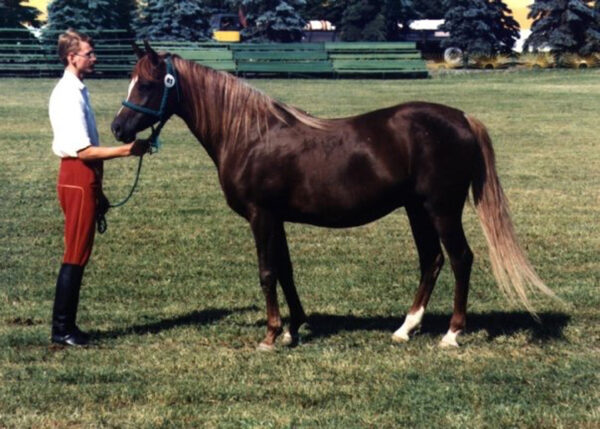
Alaxandra had been lightly backed and was well along into her first pregnancy. She had been shown once and placed in halter competition, and was in foal to our aged stallion Majid, a valuable broodmare sire and rare direct son of Malik GASB (Hadban Enzahi x Malikah) out of the influential German-bred mare Alsachra Bint Amal (Morhaf x Amal Albadeia).
One late summer day, I was home alone on the farm. It was early evening and my chores included stabling the mares who had spent their day outdoors as well as feeding all the horses their dinner. Alaxandra was in the small paddock closest to the stables with some other mares and stood quietly waiting as her friends eagerly pushed towards me to be led inside. Finally, only she was left and as usual, rather than coming to me, she waited for me to walk out to her and then allowed herself to be quietly haltered. While leading her towards the stable door, I noted that she seemed slightly off, perhaps hesitating just a fraction of a second before setting each of her feet upon the ground.
Inside the stables I checked her hooves for heat and stones and finding neither, circled her in both directions in an attempt to identify the problem. In general, she seemed bright and normal but I decided to check her temperature, which was also normal. Puzzled and only slightly concerned, I led her to her stall. She was still ‘walking on eggs’, but not what one would call lame. I usually talk to my horses and as I unhaltered her, I asked her out loud, in Hebrew: “Alaxandra, what’s wrong with you?”
Immediately I heard a voice inside my head give a clear, deliberate response. The response came also in Hebrew and was: “I have West Nile Fever.”
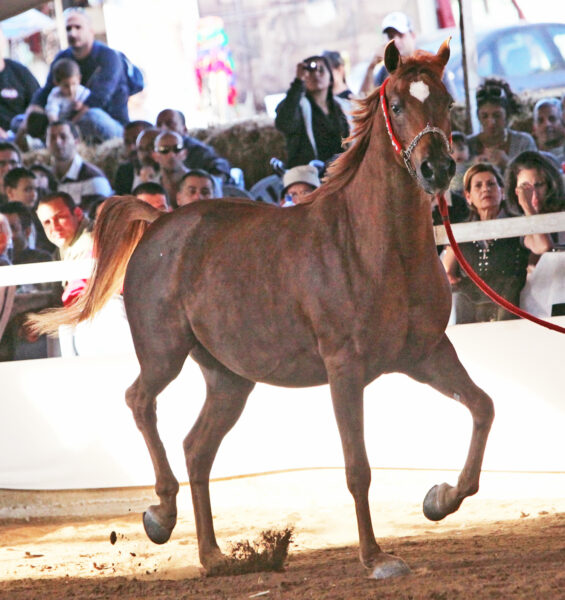
Now, there had been several times over the years when I personally had experienced what one might describe as emphatic or even telepathic communication with certain horses. But a horse answering a direct question with a direct answer? This was beyond spooky and I was absolutely stunned. I knew what I had heard and was fairly sure that I hadn’t suddenly gone truly and entirely mad.
So I did what I thought the responsible thing: I phoned Dr Noga, our veterinarian, while observing that Alaxandra was eating her hay without her usual enthusiasm and leaving her grain untouched, often a sign of trouble. Dr Noga and I were good friends and greatly respected one another, but I wasn’t about to tell her over the phone that I knew my mare was sick because she had provided me with her own diagnosis. Instead, I tactfully asked whether she thought we might have anything in our medicine cabinet that could help a mare that I suspected might have West Nile Fever but who was, for the most part, asymptomatic.
Dr Noga was sure that we did not and offered to drive right out, but I was about to be late for an important evening engagement that could not be postponed, one that would take me far from the farm. Since Alaxandra did not appear to be in distress, we agreed to confer early the next morning. I checked the mare one last time before locking up and heading off the farm.
The next morning, I was awake just after 5am to attend to farm chores. As I pushed open my back-screen door, I heard a horse let out a very long, loud frantic whinny, seemingly a cry for help. I knew deep inside that Alaxandra had heard the door open and was calling for me and headed to the horse barn at a run. I found her staggering around her stall, completely soaking wet from a high fever, and somewhat bruised and scraped on her legs and along the sides of her body. I phoned Dr Noga to come quickly, grateful that she lived only twenty minutes away. Noga advised me to keep the mare on her feet if I possibly could.
After unlocking and opening the farm gates, I managed to get a halter on Alaxandra. Her balance was precarious by the time Noga arrived and the vet was concerned that the mare might fall upon or otherwise injure me. We moved the horse from the stall adjacent to hers and I relocated there, holding Alaxandra’s lead rope above and over the low wall dividing the two stalls. This wall would protect me and also support the mare. Alexandra stood facing me with her chest pressed right up against it and with her head and neck extending over it while Noga made her examination.
It came as pure anti-climax when Dr Noga confirmed Alaxandra’s diagnosis.
Treatment involved rigging up a drip feed of medication set for slow but steady delivery over two hours. It was important that the mare remain perfectly quiet throughout, preferably standing. Using a tie ring attached to the back wall of the second stall, we set up the drip and I stood on a low chair facing my mare, applying pressure to the lead rope to steady her up against the wall. From this position I could also observe and manage my end of the drip while Dr Noga managed the horse’s end.
It only slowly dawned on me that my typically aloof and independent mare had undergone a distinct change in character. She was watching and listening to us intently, as if she had made the decision to put herself totally into our hands. I will especially never forget how our eyes were locked together over the two long hours that it took to feed out the drip. For the duration, Alaxandra stood braced against the wall staring directly into my eyes, her gaze never wavering, and I didn’t dare look away. It was as if the power of our locked gaze was the only thing keeping her upright and I swear I could actually feel a vibrational energy flowing between us. When Dr Noga finally removed the needle from the mare and instructed me to unsnap the lead rope, Alaxandra collapsed onto the stall floor.
Once down, she remained down. We spent a heart-breaking day carefully tending to her and intervening as necessary while she aborted the long-awaited Majid filly. The dead foal was not in the proper foaling position and its difficult delivery resulted in the displacement of her bladder; Alaxandra strained so hard that it seemed as if she were preparing to deliver this as well.
After hours of unsuccessful attempts at cleaning, irrigating and massaging the balloon-like organ back into place, we called for help from Dr Tuvia, a very experienced equine vet who had apparently seen it all. When Tuvia, arrived he brought with him several kilos of ice cubes and then demonstrated his unorthodox method of re-inserting and relaxing the bladder back into its rightful seat. Afterwards he refused to present a bill, insisting that he was just helping a colleague in need of assistance.
Before she left the farm that day Noga explained that it was now up to the mare and Mother Nature. It might take a few days before we would know how Alaxandra would fare. Meanwhile we were to supply fresh water and hay if she was interested and, if possible, occasionally turn her over to help her circulation and slow the formation of painful bedsores. Noga would return in two days.
When Noga next returned Alaxandra was still down, flat out. She had not made one single attempt to stand and both of us were in her stall while Noga examined her. She explained that there was a time frame within which the medication would either work or not work, and that we could allow Alaxandra another 48 hours to improve. But, if she hadn’t at least attempted to get up by then, it would be best to end her suffering.
Noga then told me that there was another issue: In two days time, she would be gone for a weekend seminar and that if Alaxandra did not improve I would have to bring in another veterinarian to actually put her down. She cautioned that trying to convince a vet to euthanise a horse that was not his patient was practically impossible, and that I should be prepared to be refused. After digesting this news, I begged her to leave the lethal injection with me so that, if necessary, I could give it to Alaxandra myself, although I knew that this was illegal. The other choice, I told her, was that she come back the following day and, if there was no change, that we end things then.
Noga answered that this sort of situation was, for her, both personally and ethically, the hardest part of being a veterinarian and then quietly began to cry. I soon joined in with my own tears; I did not want to lose my mare, nor did I want her to suffer any longer than necessary. We found ourselves grabbing and hugging each other. Alaxandra was closely observing us and had clearly understood the direction of the conversation, or at least our body language. She deliberately raised her head and looking directly at us made her first failed attempts to get to her feet. The message she conveyed was crystal clear: “Don’t you dare give up on me.”
We didn’t and Alaxandra survived, yet her story has a bittersweet ending. Within a day or so, she did finally manage to get to her feet and spent a few more days scrambling around and falling and then standing up again, until she finally totally regained her balance and fine motor control. Over several weeks, the bedsores and bruising healed, her appetite picked up, and she regained the weight she had lost. Soon she was looking and acting perfectly fit and healthy, but there was a problem, and a major one at that: according to the country’s best reproductive vets, the abortion had damaged and scarred her cervix to the extent that Alaxandra could not carry a pregnancy to term, nor could she sustain a viable embryo long enough for transplanting into a recipient mare. Her career as a broodmare was finished.
With heavy hearts, we eventually gifted the mare to friends who had set up a handicapped riding programme with the stipulation that she never be sold, thinking that this would be a good fit for her. Alaxandra proved too much horse for their young riders and our friends broke their promise to us, selling her to finance the purchase of a more suitable mare for their programme. We later befriended Ahmed, Alaxandra’s proud new owner and gifted him the mare’s papers. We would occasionally visit the two of them. Ahmed simply refused to believe us concerning her unfitness as a broodmare and spent several breeding seasons attempting to get her in foal. He would insist that she had been pregnant only to reabsorb – his own wishful thinking – and certainly she never reproduced.
More importantly, and on the bright side, Alaxandra’s owner is completely and absolutely smitten with her. She has become a brilliant riding mare and has been granted a charmed life where she is treated like the queen that she is. Having no herd mates over which to rule, she has given her heart completely to her human friend.
Part four will be published next week.