Between 2011 and 2016, Betty Finke was a regular columnist for The Arabian Magazine. Some fifteen years down the line, we thought that now would be a good time to share Betty’s articles, which remain as pertinent as ever.
Hollywood has a lot to answer for. They may not have invented the archetype of the black stallion, but they certainly helped to popularise it. And I have the suspicion that this is at the bottom of the abiding popularity of black Arabians.
It started back in the 1950s. If you grew up at the time I did and loved horses, one of your childhood favourites would have been a TV show called Fury. Despite the title, it was not a show about juvenile violence, but about the friendship between a young boy and a magnificent black stallion, the sort of bigger-and-better-than-life equine companion we all wanted to have at that age. For those of us who watched it at the time, Fury was the magic horse of our dreams.
Fury wasn’t actually called Fury, and he wasn’t an Arabian. His real name was Highland Dale, and he was an American Saddlebred foaled in 1943. He was also a genuine equine movie star, starring in many films during the 1950s. In Gypsy Colt (1954) he was owned by a little girl, and after being sold, made his way home across hundreds of miles and unimaginable hardships. In The Lion and the Horse (1952) he battled a mountain lion – and won. He guest starred in various popular TV shows. And at least once, he appears to have played an Arabian. There’s a 1951 film called Flame of Araby, in which the titular ‘Flame’ is a black stallion that certainly looks very much like him.
To anyone even slightly familiar with the Bedouins and their horses, this film is a true gem of unintentional comedy. It features a Bedouin prince called Tamerlane, who dresses and acts like a cowboy, except that instead of a hat, he has a scarf tied around his head. Tamerlane has two interests in life: the princess Tanja and the stallion Shazada. The Arab princess bears a distinctly German name, is played by the red-haired Maureen O’Hara, and spends her time riding around the desert in pants on an Appaloosa. At another point, she rides a buckskin Quarter Horse and Tamerlane a Paint, the Western saddles discreetly hidden beneath colourful blankets. Shazada at least has an Arabic name, but he is black and leads a herd of mustangs. The whole thing is sublimely ridiculous, and I warmly recommend watching it if you want to have a really good laugh.
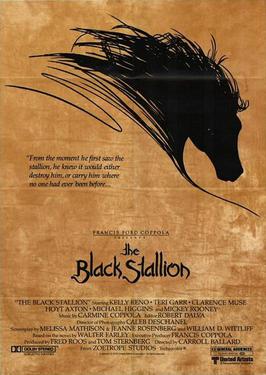
Ludicrous as this may be, it marks the point where the archetypal wild black stallion of Hollywood became an Arabian. Or sort of an Arabian, anyway… Someone who did this a lot better was, of course, Walter Farley with the Black Stallion series of books. The Black is much closer to the real thing, but he is still a highly uncommon sort of Arabian. He is a lot bigger than your average Arabian, a lot wilder – anything but good PR for the Arabian temperament! – and a lot faster, being able to run Thoroughbreds into the ground, and, of course, he is black. When the book was filmed in the 1970, he was actually played by a genuine Arabian stallion, which was probably the first time an Arabian was played by an Arabian, although in a later TV series, sadly, a Quarter horse got the role.
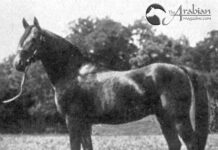
Our fascination with black Arabians is usually explained by saying that they are rare. This would probably have once been the case – after all, black is not the most practical of colours for a creature living under the blazing desert sun. Because of their popularity, we now have far too many black Arabians to call them ‘rare’; but for the same reason, you don’t find a lot of really superior ones. It makes sense. Since blacks were rare, they were sought after and invariably used for breeding. If you breed primarily for colour, other things may suffer as a result. The really outstanding blacks, the Simeon Sadiks of this world, are often accidental blacks, not the result of breeding for colour at all.
But rarity alone doesn’t explain that abiding fascination. This focus on black appears to be a distinctly American/European phenomenon. At least, I don’t know of any Middle Eastern stud farm specialising in the colour black. The EAO has produced blacks, including several of note, but not because they bred for the colour; they just happened. Come to think of it, the great European breeders of history didn’t make any such attempt either. Neither Crabbet Park nor Janów Podlaski nor the Duke of Veragua made a point of breeding blacks.
No, it’s just us, the post-Hollywood generation, raised on stories of magic black stallions. Because that’s what they all are in the end, whether they’re called Fury or Black Beauty or just The Black: magic horses. And who wouldn’t want their very own magic horse – that beautiful, brave, spirited stallion that answers to just his one special person?
Of course, horses like that don’t exist outside of films and books. But Arabians do, and many of us are lucky enough to own an Arabian. And even if he may not be black, and he may not even be a stallion, he is an Arabian – and that’s as close to owning a magic horse as anyone can get.
First published in The Arabian Magazine May 2012