Between 2011 and 2016, Betty Finke was a regular columnist for The Arabian Magazine. As we enter a new year – and some fifteen years down the line – we thought that now would be a good time to share Betty’s articles, which remain as pertinent as ever.
If you want to build a house, you start with the foundations. And you want those to be strong. It is the part you don’t actually see, but it is the part that has to carry everything else and ensure that it will last for a good, long time. If the foundations are strong, so is your house. Certainly, you can build a house without foundations, and it might look very pretty, but if there is nothing to support that pretty shape when the storm comes, it won’t last long.
It is not a coincidence that in horse breeding, we talk about ‘foundation stock’. Breeding programmes built on solid foundations are made to endure. Take the Polish State Studs, for example. The breeding programmes of Janów Podlaski and Michalów are based on dam lines that were established some 200 years ago, and few would argue that within these two centuries, Poland created a type of Arabian horse that is distinctive, special – and prepotent. During the past decade or so, Poland has introduced all sorts of ‘fashionable’ non-Polish stallions, yet the results remain unmistakably Polish Arabians. They may have a little bit of extra type, but they retain everything that made Poland’s Arabian so successful. And that is because the foundation is strong. No matter what you throw at it, it can absorb new influences and make them its own. The resulting changes are so subtle that progress is made without loss of identity.
Crabbet Park, too, was founded on strong mare families. Stallions came and went, but the families endured and have long outlived the stud that created them. Marbach State Stud, the oldest continuously existing Arabian breeding programme in the world, is another. While adding new blood from time to time, it still keeps its original foundation families. So does Al-Marah Arabians in the USA.
Or take Lodge Farm, featured in this issue. Lodge Farm was originally built on one very special mare named Kazra (Mikeno x Razehra). Kazra herself was the product of the breeding programme of Barton Lodge, which was in turn built on one strong foundation mare, the desert-bred Nuhra. Kazra remained the one constant during the development of the Lodge Farm breeding programme, which was revolutionary at its time in that it expanded to take in and blend bloodlines from all sources. This was the stud where El Shaklan (Shaker el Masri x Estopa) began his world-spanning breeding career, the stud that introduced the first Arabians from Egypt and Spain to Britain, a true pioneer in modern British breeding. But through it all, Kazra’s family remained and it, too, expanded and became a major force in Arabian breeding. Maleik el Kheil (ex Muneera by Fakhr el Kheil), one of the all-time great British-bred sires, certainly was one of El Shaklan’s greatest sons – but the bottom line is, quite literally, that he came from the family of Kazra. In fact, Lodge Farm was one of the rare private studs that succeeded in creating its own recognisable type of Arabian, a type that united a broad range of ingredients and in the end was so much more than the sum of its parts. And while many mares were purchased through the years, only three had enduring families within the breeding programme. And the first and foremost of them, the philosopher’s stone in the alchemy that was Lodge Farm, was Kazra.
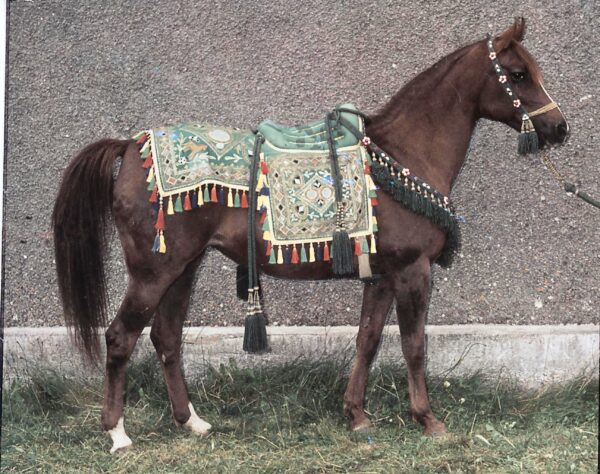
Mares like that don’t happen every day, especially those select few that almost single-handedly create entire breeding programmes such as Kazra, Tarantella (Indian King x Dancing Sunlight), Nuhra, Estopa (Tabal x Uyaima) or Hanan (Alaa el Din x Mona). You need a certain amount of luck to find one, especially if you are just starting out. If you have her, the next thing is to realise what you have – and never let it go. Once you have your foundation, the next step is to build on it.
I find it sad to see how quickly breeding programmes come and go today, taking in and dismissing horses without going very far. Breeding is ruled by fashion these days: if it wins, get it. Some farms now have collections rather than breeding programmes. Whereas in the old days if you went to the shows, you could see one generation follow after the next, today all you get to see is the newest wave of fashionable imports. In the youngstock classes at the British Arab Horse Society show, it started many years ago with more and more horses being sired by imports. Nothing wrong with that basically; but today, a lot of the dams are imported as well. Whatever happened to continuity?
The saddest thing is when even established breeders decide to not just adapt, but to ditch their entire programmes. On the Continent, a long-established breeding programme begun after the War had created a wonderful, distinctive herd based on two foundation mares, representing several generations of breeding. It is all gone today, after the original owner’s successor decided to go straight Egyptians. The best you can say for that is, at least there is a concept behind it. But some people buy new stock so fast, it is hard to keep track of what they are trying to do; trying to win, probably. Naturally, it is a lot faster to buy your winners than to breed them yourself. The former takes an eye for a horse and enough money; the latter also takes both of these, but most of all it takes a lot of planning, dedication, and time. You need to know your bloodlines, to know what you’ve got and where you want to go. You’ll probably make mistakes along the way; but that’s all right. Did Crabbet Park make mistakes? Did Lodge Farm? Of course they did. “Breeding,” as a wise man once said, “means thinking in terms of generations.”
So yes, it takes longer and the path is not likely to be straight and narrow. But in the end, you may create something that outlasts the dictates of the day. Fashions come and go; it is the solid foundations that endure.
Printed in The Arabian Magazine May 2011