Between 2011 and 2016, Betty Finke was a regular columnist for The Arabian Magazine. Now some fifteen years down the line, we thought it would be a good time to share Betty’s articles, which remain as pertinent as ever.
It is that time of year again. As I write this, we are more than halfway through August, and – even though it looks like November outside – it is getting on for September. For Arabian horse people, September is the magic month.
A good four weeks from now, many of us will be packing our bags and setting out on our annual pilgrimage to the All Nations’ Cup, to see and cheer the finest Arabian horses that the world has to offer. Once a year, this is where the entire Arabian world comes together: an ancient city close to the western border of Germany called Aachen.
Aachen is Germany’s capital of horses. If you arrive by train, the first thing you see as you leave the station is a group of bronze horses. They are not the only ones. There are equine monuments scattered throughout the city, as well as numerous life-size model horses painted in different patterns and colours.
This is not because of the All Nations’ Cup. Long before the Arabians came to Aachen, there was the CHIO, one of the biggest, most famous and prestigious horse shows in the entire world. For ten days every June and July, Aachen is the world capital of equestrian sports, where the best riders of all nations and the finest equine athletes in the world compete for the highest honours in the classic disciplines, and the grandstands are packed to suffocation point. Tickets should be purchased as far in advance as possible, or you may not get a seat. If you don’t get in, you can watch the competitions live on TV. The CHIO makes the All Nations’ Cup look like a village fair by comparison. And it’s been held since 1924.
The first international Arabian show at Aachen was held in 1979. It was an exciting occasion, only the second international Arabian show ever held in Germany, and everybody came.
The show was held outside, in what was then the CHIO dressage arena. There were dressage and show-jumping competitions, and classes for Shagya and Anglo Arabians, and even Arabians in harness. There were no professional trainers – there would be a year later – no score cards, and no waving bags or clattering cans. And did you know that the first ever Aachen International Senior Champion Stallion came from Britain? It was the Crabbet stallion Al Malik (Marino Marini x Bright Gleam), shown by one Paul Atkinson.
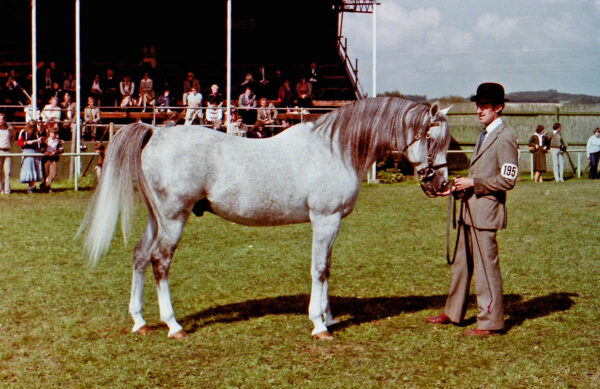
There has been an Arabian horse show at Aachen every year since then, although under different headings. In 1982, it was the German National Championships; in 1983 the European Championships and the first time the fabulous mares from Michalów in Poland appeared on the scene to blow the competition out of the water. The ridden classes were eventually abandoned, and so were the non-pure-breds. And in 1984, the All Nations’ Cup arrived at Aachen. It was the same year the show first moved indoors, because of catastrophic weather, and it has stayed there ever since. Incidentally, the senior mare championship and the highest score of the show went to a mare from Michalów Stud, Poland. Some things never change…
Today, 32 years since Arabian horses first stepped onto the hallowed grounds of the CHIO, Aachen is still the show to which everybody comes because it is the most exciting and draws the best competitors, and it is the only one with packed grandstands.
So, in a way, the All Nations’ Cup is to the Arabian world what the CHIO is to the world of equestrian sports, even if it is still a lot smaller.
However, Aachen is not just a centre of international equestrian activities. It is one of the oldest towns in Germany. The name is derived from an old Germanic word for water (ahha), and the original settlement was built around hot springs which later became Roman baths and are still in use today. The town was first documented in 765 AD, when Aachen became the residence of King Pippin the Younger, who also laid the foundations of what was to become the cathedral. Pippin’s son, Charlemagne, was Aachen’s most famous resident. Their original castle is long gone – its remains were used to build the town hall in the 14th century, also well worth seeing – but the cathedral is still there. In 1978 it became the first German building to make the UNESCO World Heritage list, and it draws a steady stream of tourists and pilgrims to Aachen throughout the year. No less than 30 kings and emperors were crowned there, including Charlemagne himself, who was also buried there. The cathedral houses his shrine as well as the finest ecclesiastical treasury north of the Alps. If you find the time, do go and see it; it is well worth the visit.