Between 2011 and 2016, Betty Finke was a regular columnist for The Arabian Magazine. Now some fifteen years down the line, we thought it would be a good time to share Betty’s articles, which remain as pertinent as ever.
This isn’t the column I was going to write. Originally, I had another subject lined up for this
issue, but then I noticed this was the British issue and that suddenly sent me off into an entirely different direction.
My own involvement with Arabians has a lot to do with Britain, and specifically with British Arabians and their breeders. There were two reasons for this. My parents spent their holidays in Britain, and from the time I was 13, they took me along. Then, when I was 15 years old, I got hold of a copy of the Arab Horse Society News. By that time, I’d seen my first Arabians in Germany and, most importantly, read Erika Schiele’s Arabians in Europe, which is probably the most obscure life-changing book on the planet.
So there was the AHS News, full of stud adverts containing addresses of breeders in all parts of the country and the enticing words ‘visitors welcome by appointment’ – and there was us, going to Britain; you get the picture.
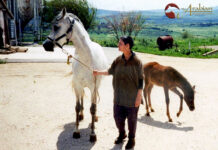
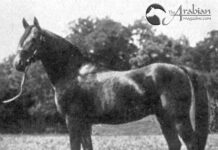
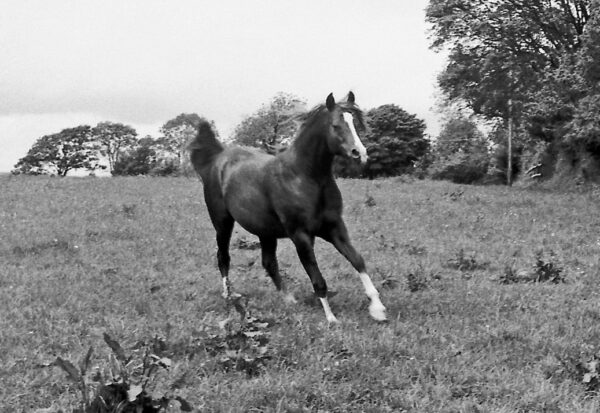
During the past four decades, I have seen more horses than I can possibly remember. But I can name and identify every horse I saw on my first-ever stud tour in 1972. And I will never forget my first sight of a British Arabian: a magnificent stallion galloping across the field towards us, mane and tail flying. He was a deep, glorious liver chestnut with a golden mane and tail, four white legs and a blaze. The farm was Margo Roberts’ Hellingtown Stud in Devon and the horse was Magic Argosy, by Argos (Nabor x Arfa) out of Fairy Magic (Indian Magic x Farette). He was actually half-Polish, but looked all English, and he almost certainly imprinted me with the image of what a British Arabian should look like.
From that year on, the Directory of Purebred Arabian Studs in Britain was my bible. I would thoroughly study it every year before the holidays, check all the stud farms within reach of where we were staying, and make a point of visiting the most interesting ones. I will be eternally grateful to my late father for going along with this and driving me to the most obscure places, even if he kept complaining about ruining his car, and my mother for doing the phone calls because I was too shy at the time. Neither of them was interested in horses, but they did come to enjoy meeting the people, who were almost invariably enthusiastic and welcoming.
Getting there was not always easy. On one memorable occasion we took a wrong turn
somewhere and got stuck in a sheep field in Wales, the farmer watching with interest while my father furiously tried to manoeuvre our rather unwieldy Ford Granada back to the road, or what passed for a road there, anyway. I am sure his thoughts at the time were totally unprintable. This was some 30 years ago, in other words, the Middle Ages – no navigation systems, not even a mobile phone to ring for last-minute instructions if you got lost, which we did quite a lot. Still, we always got there somehow, although not always at the appointed time.
There were too many special moments to mention: seeing the grand old Crabbet mare Silver Gilt (Indian Gold x Silver Fire) at age 30; visiting Newbuildings and meeting Lady Anne Lytton, although sadly it was a bit too early for me to appreciate it as much as I should have; the proud old Indian King (Oran x Indian Pride) at Goddards Green. I became expert at locating hidden treasures, including some obscure old stallions hidden away in Scotland, horses no one had ever heard of, but with rare and precious old bloodlines. Cornwall’s ancient monuments included one that wasn’t mentioned in any guidebook, but just as thrilling to me – the last living Rissalix (Faris x Rissla) son, aged 27 at the time.
The artist Margaret Stevens, whose lovely paintings graced so many old covers of the AHS News, blind and walking with the aid of a stick at the time, yet living alone with a pack of dogs and a half dozen horses. I’ll never forget the sight of this blind and crippled elderly lady leading Gold Rex (Alexus x Gleaming Gold) with nothing but a piece of string tied around is neck, one of the most stunning examples of Arabian disposition I have ever been
privileged to see.
Those travelling days are long over. Some of the people I met and many of the horses are long gone. Some of the foals I saw with their dams grew up to become famous, like a little grey colt I saw in a field in Yorkshire, unnamed at the time, who was registered under the strikingly misspelled name of Carmargue (White Lightning x Velvet Shadow). Seeing horses in veteran classes at Malvern whose ancestors I saw as foals, I realise just how quickly time passes.
But I still get a thrill when I see a horse of that so essentially British colour, a deep liver chestnut with a golden mane and white legs, because it always takes me back to where it all began: to the liver chestnut stallion galloping across the field towards me and changing my life for ever. So here’s to Margo Roberts and Magic Argosy – you may be gone, but you will always be with me.